

Plot to Kill a God
A First-Person Account from Pertinax, the Man Who Tried to Save Rome. Fall of Rome, Part 4

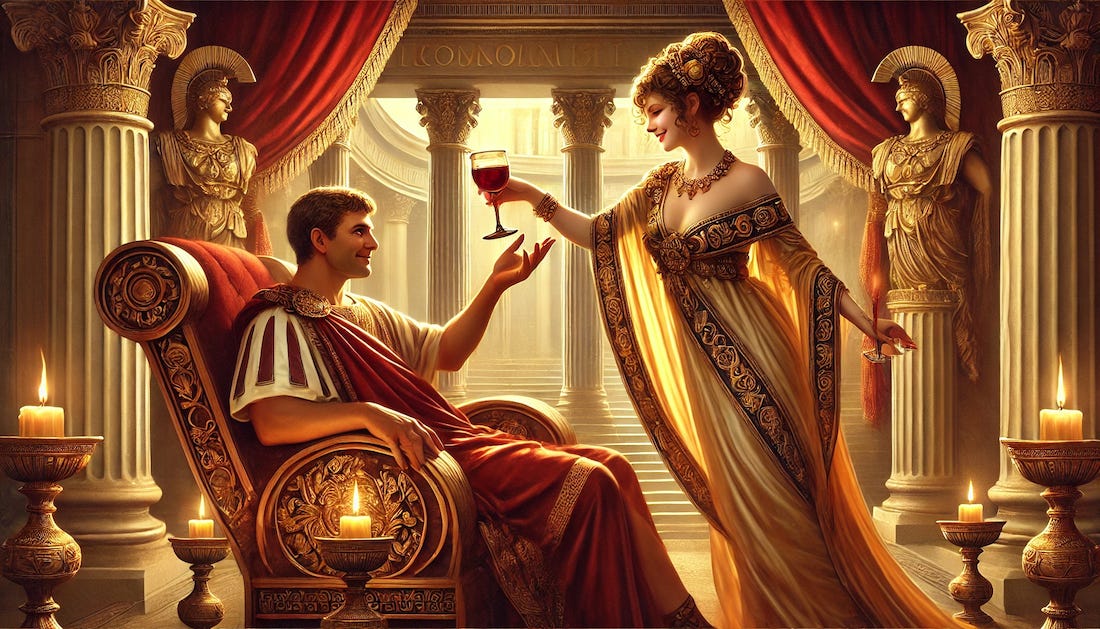
Marcia Aurelia Ceionia Demetrias was no one.
A concubine. A plaything.
The lover of Marcus Ummidius Quadratus Annianus—a man of senatorial blood, a man who had once loved the emperor’s sister. A man who dreamed of Rome without Commodus. And for that, he had died.
Marcia had not been executed alongside him. Instead, Commodus claimed her as a spoil of victory—one he had never fought for.
It was only much later that I wondered how much of it had happened exactly as she planned. Had Marcus conspired on his own? Or had he done it to please her? Did she plan to seduce Commodus?
Whatever the truth, she not only survived Marcus, she became Commodus’s mistress. She moved through the halls of power as one who had already learned the cost of defying it. She was there when he raved about gods and gladiators, when he spoke of his enemies, when he rambled on about who should die next.
She had listened to him long enough to know he trusted no one.
Not the Senate. Not his Guard. Not his generals.
Not even her.
She knew her time was up the night she found the list. Her name along with Laetus and Eclectus. The people who had served him best. The people closest to him.
And he meant to have them all executed.
She had lived in the palace too long to wait for a sentence to be carried out. She did not hesitate. She brought him wine that night.
She had served him before, had handed him goblets a hundred times over. This night was no different.
She did not let her hands shake.
She did not let her fear show as he drank.
She waited. Watched.
Then she watched him vomit it all back up.
She had failed.
But he was weak now. Groggy. Staggering.
And that was when they sent for Narcissus.
Commodus had trusted few men, but he trusted Narcissus.
He had spent years training with him, sweating beside him in the gymnasium, refining the physique he presented to the masses. He had let Narcissus throw him to the ground, pin him, correct his mistakes.
He had let this man—this man of no name, no status—teach him how to fight.
It is a cruel thing, then, that in the end, Narcissus would use that knowledge to kill him.
Commodus was still reeling from the poison when Narcissus entered.
Too dazed to fight, too sluggish to think, he stumbled toward the bath.
Perhaps he thought the warm water would soothe his churning stomach, ease the sickness from his body.
Perhaps he didn’t think at all.
The emperor stepped in. Sank deeper.
And then Narcissus was behind him.
The hands that had trained him, that had guided him in the arena, wrapped around his throat.
Commodus thrashed. His arms jerked, his legs kicked against the marble.
But he was slow. Too slow.
The poison had drained the strength from him. The wine had dulled his reflexes.
And Narcissus knew exactly how to hold him.
He had done it before, in training.
Only this time, he did not let go.
The man who had played at being Hercules was not Hercules.
The man who had played at being Jupiter was not a god.
He was just a man. And then, just a corpse floating in his own bath.
They say Rome rejoiced.
That when the word spread—first through the palace, then to the Senate, then to the streets—there was celebration. That the people tore down his statues, that they chanted the name of his successor before they even knew who he would be.
Perhaps that is true.
But I do not rejoice.
I do not raise my cup and drink to the emperor’s death.
Because I was there, too.
Not on the night of his death, no. But in the years before.
I stood beside Commodus and turned a blind eye.
I watched him bleed the treasury dry, let him prance through the Colosseum playing at war. I said nothing as he condemned men to die, nothing as he feasted while Rome starved.
And while I waited, while I convinced myself that the Senate must act, that the Guard must act, that the empire would not let itself be ruled by a madman forever—it was Marcia who did what was needed.
A concubine. A woman of no rank. A woman who had lived too long beside a god to believe in his divinity.
She saw what the rest of us refused to see.
She saw that there was no saving Rome, only cutting out its disease before it could spread.
She did not wait for the Senate.
She did not wait for the Guard.
She did what Rome had always needed someone to do.
And I, for all my years of standing at the emperor’s side, did nothing.
Disclaimer:
While The Fall of Rome: The Emperor Who Played Gladiator is a work of fiction, it reflects real events. Rome’s decline was not caused by a single emperor but by a series of rulers whose vanity, incompetence, or corruption weakened the empire from within.
Rome did not fall in a day. These emperors, through vanity, neglect, and mismanagement, eroded its foundations over centuries.
Commodus, in particular, marks a turning point. His reign transformed Rome from a powerful empire into a spectacle-driven state that valued entertainment over survival—a theme that echoes throughout history.